







OMU-Led International Team Launches the 2026 Excavation Season at the Ancient City of Parion
 LISTEN

Led by OMU, the internationally recognized Parion Excavations bring together researchers from multiple countries to advance archaeological research, preserve cultural heritage, and train future generations of scholars.
The 2026 excavation season has officially begun at the Ancient City of Parion (Parium), one of Ondokuz Mayıs University's (OMU) most significant international field research projects.
Conducted under the authorization and supervision of the Ministry of Culture and Tourism of the Republic of Türkiye, the excavations are carried out on behalf of the General Directorate of Cultural Heritage and Museums and the OMU Rectorate. The project is directed by Prof. Dr. Vedat Keleş, Dean of the Faculty of Humanities and Social Sciences and Head of the Parion Excavation, together with an international research team of approximately 35 archaeologists, academics, researchers, and students.
The excavation team includes specialists from Université Bordeaux Montaigne (France), the Higher School of Economics (Moscow, Russia), the University of Calabria (Italy), universities in Brazil, and several higher education institutions across Türkiye. The project is coordinated by the General Directorate of Cultural Heritage and Museums with support from İÇDAŞ Inc., the Çanakkale Governor's Office, and the Municipality of Biga.
A Model University Research Project
Located in Kemer Village in the Biga district of Çanakkale, the Parion Excavations extend far beyond the archaeological investigation of an ancient city.
For nearly two decades, the project has combined scientific research, higher education, international collaboration, cultural heritage preservation, and public engagement within a single university-led initiative.
Although conducted hundreds of kilometers from Samsun, the Parion Excavations serve as a prominent representation of OMU's academic identity. The OMU flag flying over the excavation headquarters symbolizes the University's commitment to scientific excellence and the protection of cultural heritage.
One of Türkiye's Leading Centers for Archaeological Research
Today, Parion is recognized not only for its archaeological discoveries but also for the academic community it has cultivated.
Many researchers who received their archaeological training at Parion now direct excavations at ancient sites throughout Türkiye. Likewise, a significant number of the country's restorers and conservators gained their first professional experience at Parion, while numerous university faculty members have built important stages of their academic careers through the project.
A Major Contributor to Archaeological Scholarship
The excavation has also made substantial contributions to academic research.
To date, the project has produced more than 20 scholarly books, numerous national and international journal articles, and has provided the scientific foundation for over 20 doctoral dissertations and hundreds of master's theses.
The internationally recognized Parion Studies publication series has become an important reference source for scholars both in Türkiye and abroad.
Meanwhile, thousands of archaeological artifacts recovered during the excavations have been added to Türkiye's national cultural heritage inventory, ensuring their preservation for future generations.
As a result, Parion has evolved into more than an archaeological excavation, it has become a living research center that generates knowledge, trains future scholars, and safeguards cultural heritage.
The 2026 Season Extends Beyond Archaeological Excavation
This year's excavation campaign focuses primarily on the Southern Necropolis and the ancient city's Agora.
Research in these areas is expected to yield new evidence illuminating Parion's long history and to bring numerous newly documented artifacts into the scientific record.
The 2026 program also includes several heritage conservation initiatives beyond excavation.
Within the framework of an integrated approach to cultural heritage preservation, a project has been prepared to document, conserve, and exhibit Ottoman-period gravestones located in the cemetery surrounding the Kemer Village Mosque. In addition, preparations have begun for an underwater archaeological survey to investigate the remains of a presumed Ottoman shipyard within the ancient harbor.
Through these initiatives, Parion's cultural heritage, from Antiquity to the Ottoman period, is being studied within a unified scientific framework.
A Living Center for Science and Culture
Scientific and cultural events also form an important part of the 2026 season.
Preparations are underway for the Second Symposium on Propontis and Neighboring Cultures, scheduled for April 2027, following the success of the inaugural symposium held in 2018, which attracted considerable international scholarly interest.
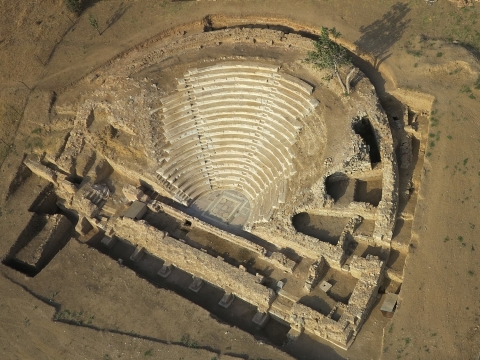
At the same time, plans continue for hosting scientific meetings, cultural events, and artistic performances in the city's Odeion, one of Parion's principal public buildings.
These initiatives reflect the project's broader vision of developing Parion not merely as an excavation site, but as a vibrant center for scientific research and cultural life.
Advancing OMU's Mission as a Leading Research University
Now entering its twentieth year, the Parion Excavation Project is widely regarded as one of Türkiye's exemplary archaeological initiatives thanks to its international collaborations, high-quality academic output, contributions to cultural heritage conservation, and strong engagement with society.
As the institutional home of this long-standing scientific endeavor, Ondokuz Mayıs University continues to fulfill its mission as a leading research university, revealing the past through scientific inquiry, protecting Türkiye's cultural heritage, educating future generations of researchers, and sharing knowledge with society.
-
 933
933 -
 1,409
1,409 -
 1,311
1,311 -
 611
611