







OMU-Led Excavations Reveal Early Christian Settlement at Apollo Smintheus Sanctuary
 LISTEN

An OMU-led archaeological team uncovered an Early Christian settlement, including a 1,500-year-old stone mortar and 1,300-year-old storage jars, revealing how the former Roman bath complex was transformed into an agricultural community.
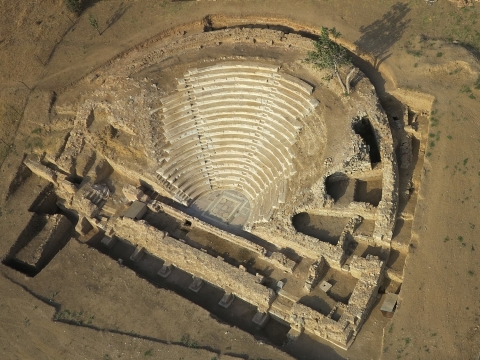
The 2026 excavation season at the Sanctuary of Apollo Smintheus in Çanakkale has yielded new evidence of Early and Late Christian occupation, shedding light on the site's transformation from a Roman religious and bathing complex into an agricultural settlement. The excavations are directed by Prof. Dr. Davut Kaplan of the Department of Archaeology at Ondokuz Mayıs University (OMU).
Excavation and restoration work at the sanctuary, located in Gülpınar village in the Ayvacık district of Çanakkale, has been ongoing since 1980 under the permission of the Ministry of Culture and Tourism and the General Directorate of Cultural Heritage and Museums, with coordination by the Çanakkale Governorship. Since 2011, the project has been officially sponsored by İÇDAŞ Inc., with Hydro Works Engineering Ltd. joining as an additional sponsor three years ago.
Evidence of an Early Christian Agricultural Settlement
The 2026 season began approximately two weeks ago and is currently focused on the Western Bath, one of three Roman bath complexes within the sanctuary's bath district.
During excavations at the entrance to the bath, archaeologists identified two distinct Late Antique occupation layers. Among the discoveries were a 1,500-year-old stone mortar associated with an Early Christian settlement and 1,300-year-old pithoi (large storage jars) belonging to a later phase of Christian occupation.
According to Prof. Dr. Kaplan, these findings demonstrate that, after pagan worship was prohibited, architectural materials from the sanctuary were reused by Christian communities, who established a new settlement over the abandoned Roman bath complex.
"Within just two weeks, we identified two separate Late Antique Christian occupation layers above the Roman bath. The earlier settlement includes a stone mortar, indicating an agricultural community. Directly above it lies a later Christian occupation layer, although evidence from this phase is more fragmentary because agricultural activity has disturbed much of the archaeological record."
Roman Engineering Meets Later Reuse
Excavations have also revealed remarkably well-preserved elements of the Roman bath itself.
Researchers documented the caldarium, the bath's heated room, together with its wall and underfloor heating systems dating back approximately 1,700 years. The excavation continues to expose the hypocaust system, the sophisticated Roman underfloor heating technology that distributed hot air beneath the floors and inside walls.
These discoveries provide further insight into Roman engineering and illustrate how infrastructure that once served public bathing was later adapted for entirely different purposes by subsequent communities.
Changing Ways of Life
Prof. Dr. Kaplan explained that archaeological evidence suggests the Early Christian inhabitants relied primarily on agriculture. The stone mortar and other finds indicate food processing and storage activities associated with everyday rural life.
Later occupation layers have yielded large storage jars used to preserve agricultural products, reinforcing the interpretation that farming became the dominant economic activity after the Roman bath ceased to function.
"The Roman baths originally served hygiene and public life, but we do not see the same emphasis on bathing among the later Christian inhabitants. Instead, the complex gradually lost its original function and became home to a Christian community engaged in agriculture and animal husbandry."
The discoveries provide valuable evidence for understanding the social and economic transformation of the sanctuary during Late Antiquity, documenting how one of Anatolia's important Roman religious centers evolved into a rural Christian settlement.
-
 835
835 -
 1,467
1,467 -
 1,366
1,366 -
 254
254